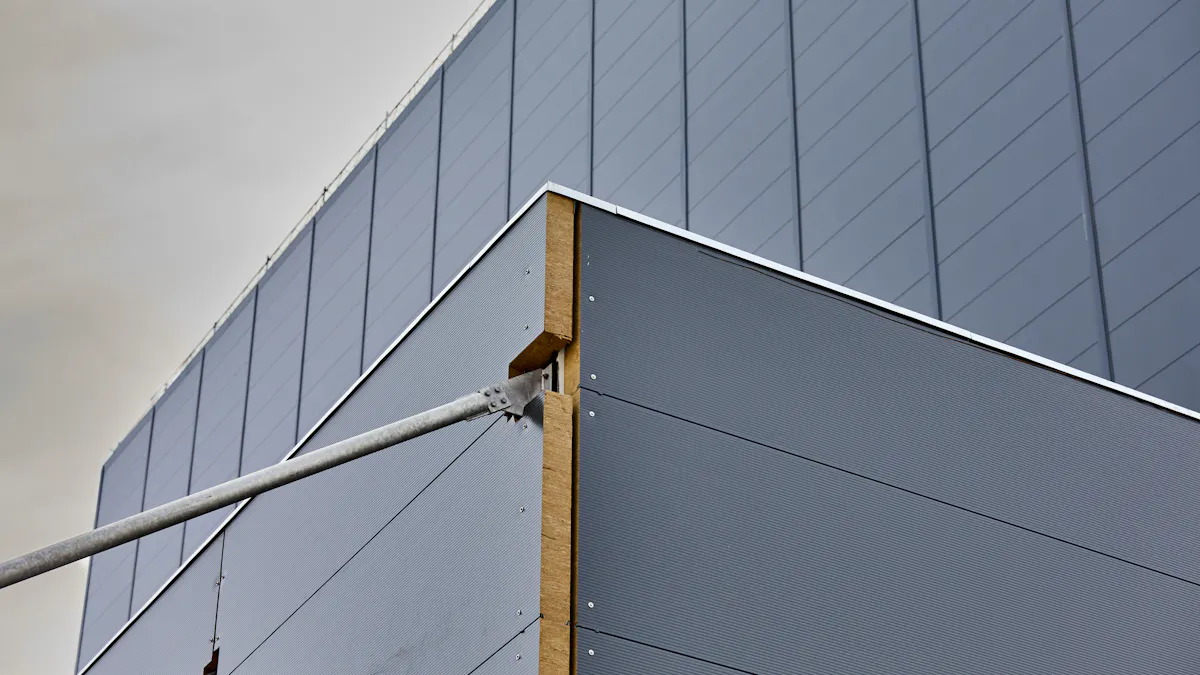
© Images courtesy of Simon Kennedy

Driven by growing demand for artificial intelligence (AI), high-performance computing (HPC), cloud migration and digital sovereignty, data centres are evolving into highly specialised, energy-intensive infrastructure. 


As the density of server racks increases from traditional levels of around 20 kW to 100–200 kW per rack, the management of heat, electrical loads and risks is becoming increasingly important. Whilst the building structure itself accounts for only 10–15% of total capital expenditure, the building envelope is the first and final physical barrier protecting equipment, operational availability and service continuity. 


As a result, insulation needs to do more than manage heat loss. It needs to support fire protection, thermal stability, acoustic control and long-term durability while working as part of the building envelope and the systems that protect critical equipment. 

01

Fire protection for data centre systems

Data centres contain high-value equipment, making fire protection a key requirement for both the building envelope and internal compartmentation. A fire can damage critical equipment, disrupt operations and affect service continuity. Fire-rated construction and compartmentation can help limit the spread of fire and protect areas such as server halls, battery rooms and transformer vaults. Stone wool meets these specifications through its non-combustibility. It can withstand temperatures exceeding 1,000°C, helping protect equipment in the event of fire. When integrated into a sandwich panel, the complete system can achieve up to A2-s1,d0 according to EN 13501-1.

02

Durability and sustainability over time

Data centre infrastructure is designed to operate for many years, while facilities may evolve through upgrades, changes in equipment and changing requirements. This makes long-term building performance an important consideration, including the ability of insulation to maintain its properties over time. Stone wool is dimensionally stable and resistant to ageing, moisture and temperature cycling. It is also water repellent and vapour open, helping maintain insulation performance over time. For projects where environmental information is required, stone wool can be supported by Environmental Product Declarations (EPDs). Our stone wool range for sandwich panels: Spanrock®, also hold Cradle to Cradle® Material Health Bronze certification in 10 of our factories.

03

Acoustic control for quieter sites

Generators, chillers, ventilation and other cooling equipment can make data centres a significant source of noise. Controlling sound can become a real challenge, particularly for data centres located close to urban and residential areas. Acoustic insulation should therefore be considered as part of the building design and construction process to help limit sound transmission. Stone wool can be integrated into acoustic barriers, silencers, AHU casings and plant enclosures to help manage noise from data centre equipment. Thanks to its open fibre structure, stone wool absorbs airborne sound and can also help dampen low-frequency vibrations, making it suitable for applications where acoustic control is important.

04

Thermal stability for efficient cooling

As server rack densities increase, data centres generate more heat, putting greater demands on their cooling systems. To maintain stable temperatures, these systems need to work harder, making the thermal performance of the building envelope increasingly important. Stone wool sandwich panels can help limit unwanted heat transfer and thermal bridging, helping maintain a stable indoor environment and reduce the load on cooling systems. Stone wool provides stable thermal performance, with resistance to sag and dimensional change over time. Its dimensional stability also helps keep joints tight, supporting airtightness and reducing the risk of air infiltration and moisture ingress.

The data center is probably the only type of infrastructure where the building accounts for just 10 to 15% of the asset’s overall budget. For operators, the priority remains performance, together with a carefully designed architectural object, well integrated and locally accepted.

Emma North

Data Center Expert, Impulse Partners

A stone wool core engineered for your system

Requirements can vary from one data centre to another, and so can the insulation needs. A smaller data centre located close to a city, for example, may have greater acoustic requirements, while larger facilities can have different requirements for thermal performance, fire protection or equipment integration. 

The stone wool core can therefore be engineered around the application — from density and thickness to facings, fibre orientation, tolerances and pack format. Testing and sample trials can also support the development and certification of the system. 

The result is a core designed around your requirements and the way your system is produced, rather than a standard product that you have to adapt. 

Built in 2015 in Slough, UK, Equinix LD6 International Business Exchange™ is one of the largest internet exchanges on the Equinix London campus. Designed to operate around the clock, the facility required an envelope that could provide high fire safety, stable internal conditions, physical security and fast construction alongside existing buildings. 

The 10,803 m² facility uses steel sandwich panels with 120 mm stone wool cores. The stone wool cores help contain fire and limit flame spread, while providing thermal insulation to reduce heat transfer through the façade and support efficient cooling. 

Want to find out more about the project?  

 
Building construction photo series of the LD6 Equinix International Business Exchange™ (IBX)

© Images courtesy of Simon Kennedy

Frequently Asked Questions

What is a data centre and how does it work?
What are the main challenges when designing a data centre?
Why is insulation important in data centres?
What type of insulation is suitable for data centres?
How does insulation help with data centre cooling?
Why is fire protection important in data centres?
Can sandwich panels be used in data centres?
Why use stone wool insulation in data centres?